ICOFIT: Investigating Visual Complexity, Context Switching, and Individual Dispositions for Safe Teleoperation
- Contact:
- Project Group:
Human-Vehicle Interaction
- Funding:
Deutsche Forschungsgemeinschaft (DFG)
- Startdate:
September 2026
- Enddate:
August 2029
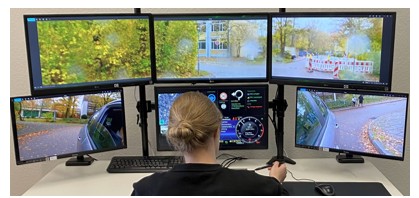
Highly automated vehicles may reach their functional limits in complex or unclear traffic situations. Teleoperation can serve as an important fallback mechanism in such cases, allowing remote operators to assist or control vehicles from a distance. Our project investigates the psychological demands and stressors that arise in this context, particularly with regard to visual complexity, frequent context shifts between situations, vehicles, or interaction modes, as well as the individual performance capabilities of the operators. The focus is on perception, situational understanding, mental workload, and performance.
Particular attention is paid to event-based remote assistance, in which remote operators support vehicles without directly taking control of them. Experimental studies systematically examine cognitive demands, interaction design, and appropriate support mechanisms. The results are intended to help design teleoperation workstations that are safe, efficient, and human-centered, and to derive recommendations for task allocation, workload, and interface design.